Start with cash received and cash owed
A home equity agreement can replace a monthly bill with a future settlement. The CFPB describes these products as an upfront payment followed by a lump sum tied partly to home value. The absence of a monthly bill is therefore a cash-flow feature, not a complete measure of cost.
Our comparison method starts with two questions: how much usable cash reaches your bank account today, and how much would you have to deliver on a specific exit date? Ask for both numbers in writing, using the same date and home-value assumption across proposals.
Source: CFPB · Home Equity Contracts: Market Overview (January 2025) ↗
The $100,000 headline can become $96,000 in your hands
Consider an invented example: a $100,000 gross advance, $4,000 in fees deducted upfront, and a $160,000 settlement five years later. You received $96,000, not $100,000. The difference between the settlement and usable cash is $64,000.
With no intervening cash flows, the equivalent annual growth rate of that obligation is (160,000 ÷ 96,000)^(1 ÷ 5) − 1, or about 10.76%. That is a scenario comparison rate, not a legally disclosed APR and not a quote from Housepiece or any provider.
| Cash-flow item | Illustrative amount |
|---|---|
| Gross advance | $100,000 |
| Upfront fees | $4,000 |
| Usable cash today | $96,000 |
| Settlement after five years | $160,000 |
| Settlement minus usable cash | $64,000 |
Time changes the comparison, even when the payoff is identical
Hold that hypothetical $160,000 payoff constant. Against $96,000 received, a two-year exit implies approximately 29.10% per year; a ten-year exit implies approximately 5.24%. This isolates timing. It does not predict that a real contract would charge the same amount at every date.
Ask for a grid of contractual payoff amounts at years two, five, and ten, each at lower, unchanged, and higher home values. A single attractive scenario hides how two moving inputs interact. Enter each quoted settlement separately in our calculator.
Translate the future obligation into a savings question
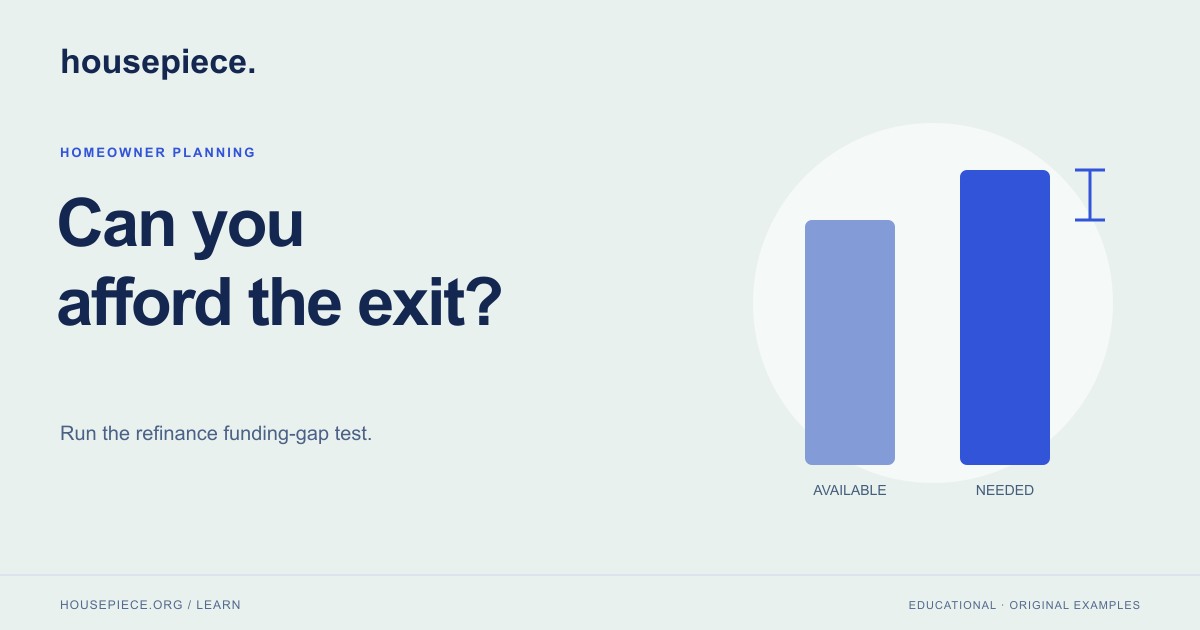
In the five-year example, building a $160,000 settlement reserve from zero would require $2,666.67 a month if the reserve earned nothing. This is not a required contract payment. It is a planning stress test: if you want to stay in the home and avoid refinancing, where would the settlement cash come from?
Separate the ability to make monthly payments today from the ability to fund a large exit later. A lower current payment burden can coexist with a difficult future exit. The right comparison is a dated cash-flow plan, including realistic alternatives and the costs of each.
Use the same measuring stick for alternatives
For an amortizing loan or HELOC, include every payment, fee, and remaining balance at the comparison date. Our simple exit calculator assumes no intermediate payments, so it cannot produce an apples-to-apples APR comparison with a loan that is paid down monthly.
Obtain actual terms before choosing. A calculator can expose assumptions; it cannot determine affordability, eligibility, tax treatment, or whether a contract fits your circumstances.
Four questions worth asking.
- What is my net cash after every closing charge?
- What is the actual settlement in nine combinations of exit date and home value?
- Which payments occur before settlement?
- What source of cash would let me exit without selling?
Editorial method: Housepiece separates source descriptions from its own hypothetical examples. This article has not received an independent legal or financial review. Contract terms and applicable law control; verify them for your property and transaction. We do not receive referral fees from providers named in these guides.